How to write a children’s story starring your child
The stories kids ask for again and again aren’t the best-written ones. They’re the ones where they recognize themselves: their name, their stuffed animal, the puddle at the bus stop.
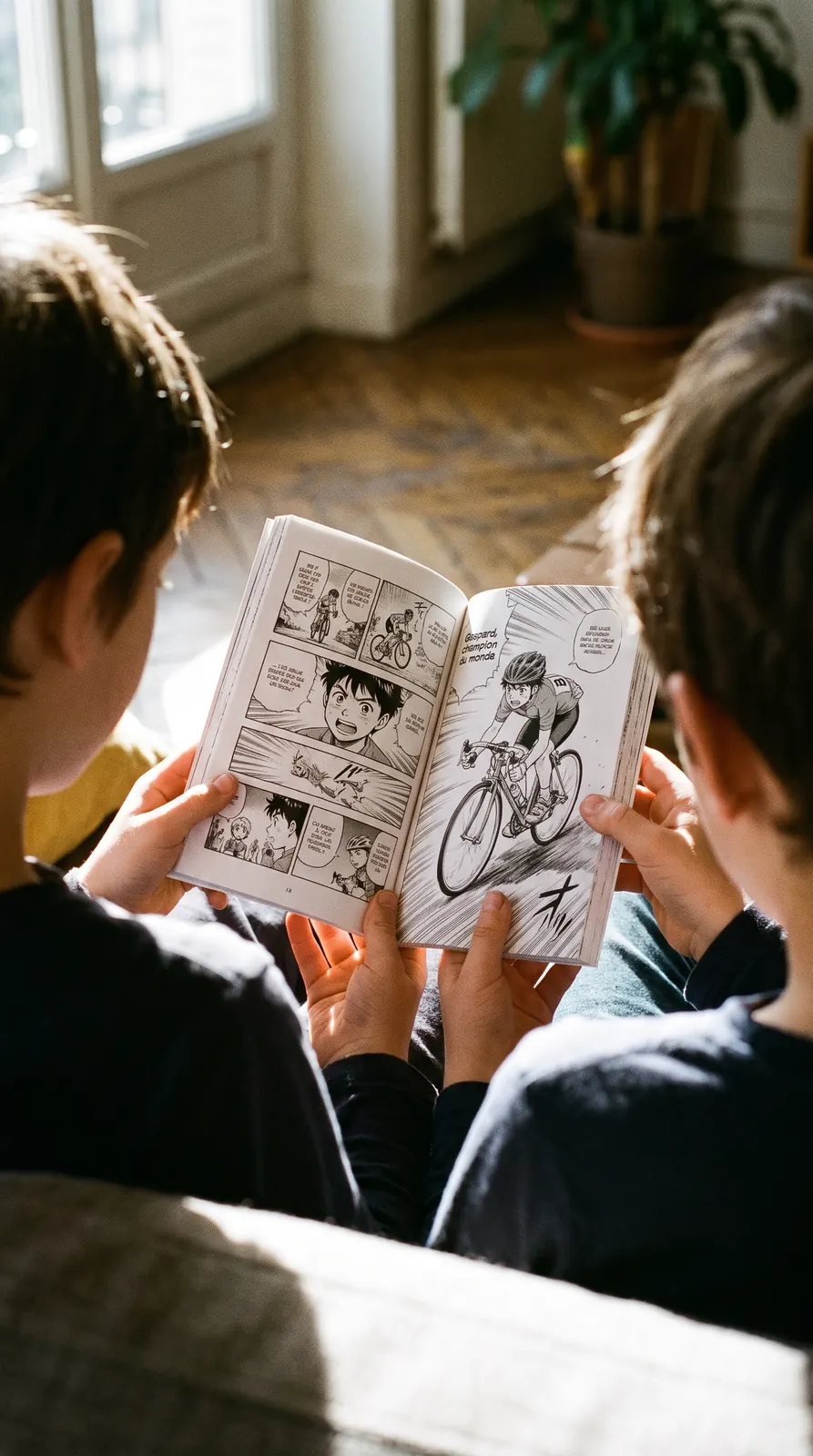
One manga, two readers. The hero is pedaling, and neither of them looks up.
Why it works every time
Kids listen politely to a story about a rabbit they’ve never met. They sit up the moment they hear their own name. And they correct you: “No, my bike is blue.” That’s it, you’ve won: they have stepped into the story.
You don’t need to be a writer. You have an advantage no author will ever have: you know the hero by heart.
The five ingredients
- 01A hero just like your child: the same name, the same cowlick, the obsession of the moment, and one small flaw worn proudly, like never wanting to put on a coat.
- 02A sidekick: the stuffed animal, the cat, the little sister, an imaginary friend. The hero needs someone to talk to.
- 03A real place: the park down the street, Grandma’s backyard, the way to school. Your child should be able to go back there in real life.
- 04A kid-sized problem: something lost, broken, off-limits, or a little bit scary.
- 05An ending where the hero is the one who figures it out. Never a grown-up who shows up and fixes everything.
Start from a real day
The best stories begin with something that really happened. The day a shoe got lost at the beach. The morning the cat disappeared. The time the big slide was too scary.
Tell the day the way it was, then change just one thing. What if the shoe had walked off on its own? What if the cat was on a secret mission? One magical detail in a world your child knows: that’s the right amount.
The three-try plot
It has been used forever, because it works.
- 01All is well: the hero, the sidekick, the place.
- 02Something happens.
- 03First try: it fails.
- 04Second try: it fails too, in a funny way.
- 05Third try: the hero has an idea, and it’s the right one.
- 06Back home, and a last line that comes back in every story.
Choose that closing line once and for all. “And that night, Leo fell asleep with sand in his pockets.” Your child will be saying it with you by the third reading.
Write for their age
Ages two to three
Ten sentences, no more. One action per page, lots of repetition, sound effects. “Splash” beats a description.
Ages four to six
A real little adventure in three tries, five minutes of reading. This is the age of almost-bad words and ridiculous grown-ups: have Dad fall into the pond.
Ages seven to nine
Short chapters that can be read alone. A mystery, a plan, partners in crime. Ask what happens next: at this age, kids have better ideas than you do.
The words
- Short sentences, in the present or the plain past tense, the way their own books are written.
- Dialogue: kids listen better to what the characters say to each other.
- Their own words: if your child says “the digger,” don’t write “the excavator.”
- A refrain that comes back three times.
- The real names of the people they love, with those people’s permission.
The pictures
You can’t draw, and it doesn’t matter at all. Three solutions.
Their own drawings: ask your child to illustrate the story, then photograph the drawings laid flat, in daylight.
Their photos: the ones from the real day, in order. One photo per page with the text underneath already makes a picture book.
A comic: a few photos arranged in panels, some speech bubbles, and the story takes on a whole new look. It’s the favorite format of seven-to-nine-year-olds.
Read it, then keep it
Read the story out loud before you print it. If your child looks away on page four, cut page four. If you get a laugh, don’t touch a thing.
Put the date on it, along with your child’s age. Then do it again next year: one story a year, with a hero who keeps growing, makes a small collection by age ten. It goes on the shelf next to the baby book and the family yearbook.
Frequently asked questions
At what age can you start writing a story for your child?
From age two, when kids recognize their name and their things in a story. Before that, what they love most is your voice and the pictures. After ten, they would rather write it themselves: help them.
Can you put brothers and sisters in the story?
Yes, and you’d better, or you’ll hear complaints. Give each one a part: the sidekick, the one with the idea, the one who saves the day at the end. And plan a story where each gets a turn as the hero.
What if I have no ideas at all?
Ask your child. “If your teddy bear went out at night, where would it go?” Write down the answer: it’s the beginning of the story, and your child is already the author.